| MOQ: | 1 panel |
| Price: | Negotiation |
| Payment Terms: | T/T |
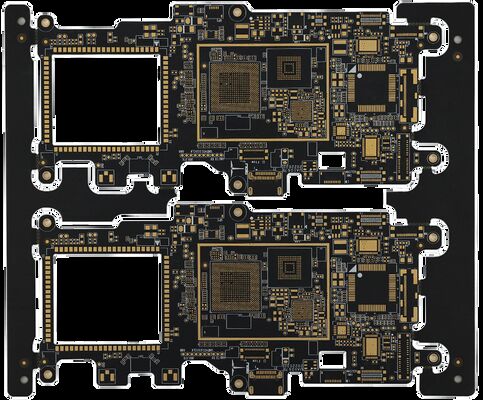
| Product type | 8 layer HDI printed circuit board |
| Material | FR4 High TG 1.6mm |
| Copper thickness | 1/H/H/H/H/H/H/1 oz |
| Surface finish | EING |
| Technology | Blind holes and resin plugging |
| Soldermask | Black |
| Line width/space | 0.1mm |
Microvias and stacked microvias can be desinged in High Density Interconnect circuit boards, also known as HDI PCBs, to enable complex interconnections in advanced designs.
Microvias, stacked microvias and via-in-pad design allow miniaturization for higher functionality in less space and can accommodate large pin-count chips such as the ones used in cell phones and tablets. Microvias will help reduce layer count in printed circuit board designs while enabling higher routing density and eliminating the need for through vias.
Consumers' growing demand for more functionality in compact and portable electronic devices—including PDAs, mobile phones, and AI products—is pushing the industry toward smaller feature sizes, finer process geometries, and more compact printed circuit boards. For engineers addressing these evolving requirements, the adoption of high-density interconnect (HDI) technology has become essential.
HDI PCB technology enables the production of circuit boards with through-hole, blind, or buried vias without relying on conventional mechanical drilling methods. To successfully implement HDI, users must not only evaluate and apply this next-generation technology, but also understand its limitations in areas such as layer stack-up design, via and microvia formation, achievable feature sizes, and the key distinctions between HDI and conventional printed circuit board technologies.